What Is The Buddhist Middle Way?
Table of Contents
What Is the Buddhist Middle Way?
Trauma Can Teach Us to Live in Extremes
Healing Can Look Like Becoming More Flexible
The Middle Does Not Mean Being Neutral About Everything
Acceptance Is Not the Same as Giving Up
The Nervous System Doesn't Always Love the Middle
Moving Away From All-or-Nothing Healing
One of the teachings I appreciate most from Buddhism is the idea of the Middle Way.
I think part of what draws me to this teaching, both personally and as a therapist, is how much of our suffering can happen at the extremes.
All or nothing.
Perfect or a failure.
Holding everything together or completely falling apart.
Always productive or doing nothing.
Trusting everyone or trusting no one.
Completely healed or completely broken.
We can become so accustomed to thinking in opposites that it can feel like those are our only choices.
But what if there is another way?
The Middle Way offers a different perspective. Not one where everything is perfectly balanced all the time, and certainly not one where we never experience pain, grief, anger, disappointment, or uncertainty.
Instead, I think it gives us permission to make room for the fullness of being human.
To experience joy and grief.
Connection and disappointment.
Growth and setbacks.
Effort and rest.
Strength and softness.
Healing and hurting.
Sometimes at the very same time.
What Is the Buddhist Middle Way?
The Middle Way, or Middle Path, is a foundational teaching in Buddhism.
Before becoming the Buddha, Siddhartha Gautama is traditionally described as having experienced very different extremes. He first lived a life of privilege and comfort and later practiced severe asceticism and self-denial in pursuit of enlightenment.
Neither extreme ultimately provided the answer he was searching for.
The Middle Way emerged from the recognition that awakening was not found through either indulgence or extreme deprivation. Instead, the Buddha taught a path that avoided these extremes.
Over time, Buddhist traditions have explored the Middle Way in deeper philosophical ways, but this original teaching has always resonated with me because of how human it feels.
We often search for certainty at one end or the other.
And sometimes healing asks us to become more comfortable somewhere in between.
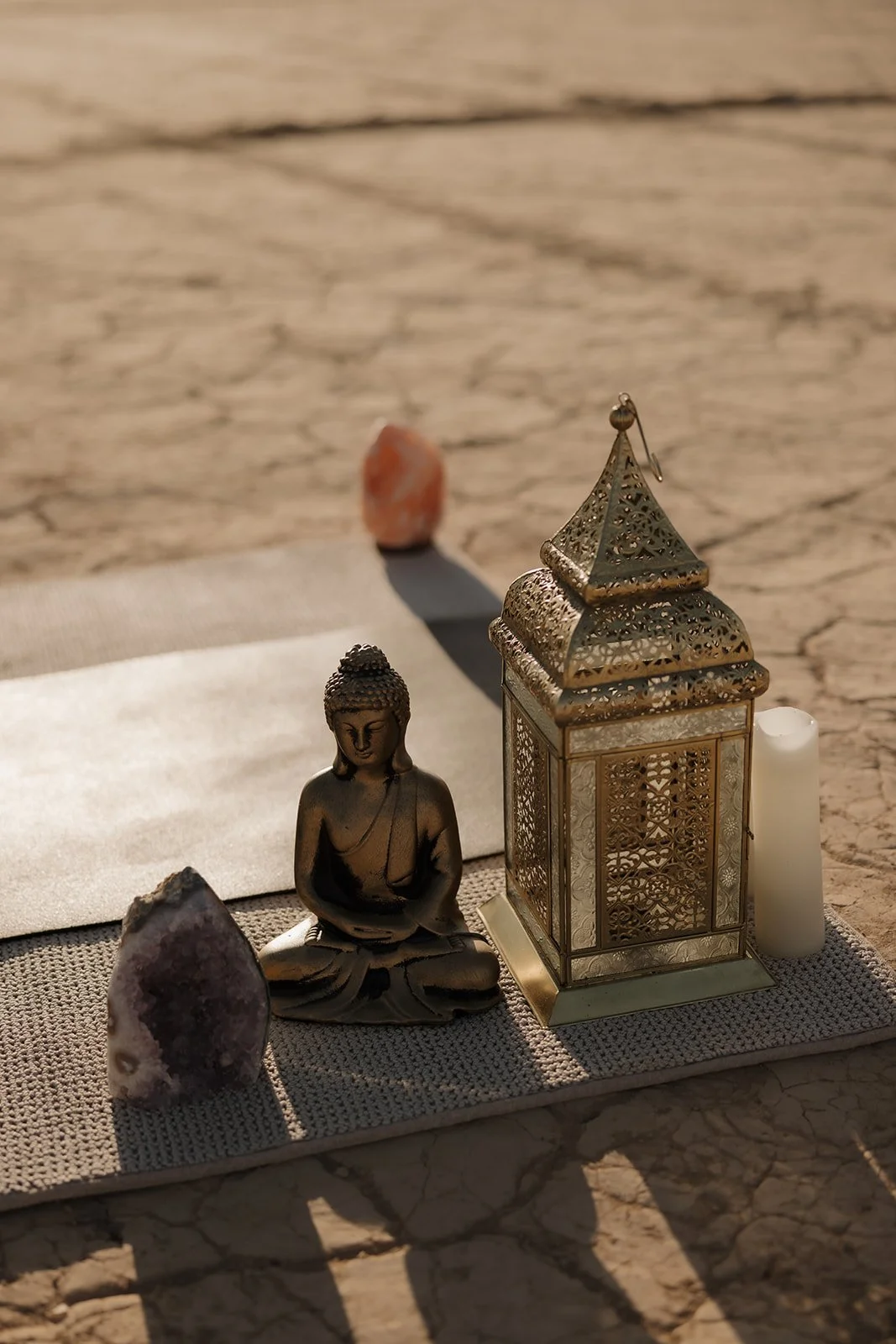
For a beautiful deeper exploration of this idea, Buddhist teacher Jack Kornfield writes about the Middle Way as learning to be present with the complexity and changing nature of our experience.
Trauma Can Teach Us to Live in Extremes
As a trauma therapist, I see versions of this all the time.
Someone learns very early that being useful, responsible, or productive helps keep them safe. Eventually, resting starts to feel uncomfortable.
Someone learns that depending on another person leads to disappointment. Eventually, independence becomes, "I don't need anyone."
Someone grows up around unpredictable emotions and becomes incredibly skilled at reading everyone else. Eventually, another person's disappointment feels like something they have to fix.
Someone has been hurt in relationships and understandably becomes protective. Eventually, vulnerability itself begins to feel dangerous.
These patterns usually did not appear for no reason.
Many of the extremes we judge ourselves for were once attempts to create safety.
Hyper-independence may have helped when other people were unreliable.
Perfectionism may have reduced criticism.
People-pleasing may have helped maintain connection.
Emotional shutdown may have protected us when having feelings was not safe.
Hypervigilance may have helped us anticipate what was coming next.
The goal of healing is not to shame these responses or rip them away from us.
It is to help us develop more choices.
Healing Can Look Like Becoming More Flexible
When people imagine healing, they sometimes imagine arriving at a place where difficult emotions no longer happen.
I don't think that is what healing asks of us.
You can do years of therapy and still feel anxious sometimes.
You can develop a secure relationship and still occasionally fear losing it.
You can become much better at setting boundaries and still feel guilty after saying no.
You can process trauma and still have moments when something touches an old wound.
You can love yourself and still have days when you struggle with yourself.
The presence of discomfort does not automatically mean that healing has failed.
Sometimes healing looks less like eliminating one side of the human experience and more like increasing our ability to move between experiences without becoming completely consumed by them.
I can work hard and rest.
I can care about someone and have boundaries with them.
I can be disappointed and still love someone.
I can feel anxious and recognize that I am safe.
I can be strong and need support.
I can appreciate how far I have come and acknowledge that there are still things I want to heal.
That little word and can create a surprising amount of space.
The Middle Does Not Mean Being Neutral About Everything
I think this distinction is important.
Finding a middle path does not mean tolerating harmful behavior, abandoning your values, or trying to find a compromise in every situation.
Sometimes a clear boundary is necessary.
Sometimes leaving is healthy.
Sometimes anger is appropriate.
Sometimes protecting yourself is exactly what you need to do.
The Middle Way is not about forcing ourselves into some perfectly calm center where nothing affects us.
And emotional balance does not mean having the same emotional response to everything.
For me, it is more about flexibility.
Can I listen to what this particular moment requires rather than automatically responding from an old survival pattern?
Do I need to push right now, or do I need to rest?
Do I need to hold on, or is it time to release?
Do I need protection, or is it safe enough to soften?
Do I need solitude, or do I actually need connection?
The answer may be different on different days.

Acceptance Is Not the Same as Giving Up
Another reason the Middle Way resonates with me is because of how closely it connects, in my mind, with acceptance.
Acceptance can sometimes sound passive.
"If I accept this, does that mean I'm saying it's okay?"
Not necessarily.
Acceptance can simply mean acknowledging what is already here.
This happened.
I feel hurt.
I wish this were different.
I cannot change what someone else chooses to do.
I cannot rewrite my childhood.
I cannot guarantee that I will never experience loss again.
And I can decide what I want to do with the reality in front of me.
There is a difference between accepting reality and approving of everything that has happened to us.
Sometimes acceptance actually gives us more freedom to choose our next step because we are no longer using all of our energy fighting the fact that something is true.
The Nervous System Doesn't Always Love the Middle
There is another layer to this that I find especially important in trauma therapy.
The middle can feel uncomfortable when your nervous system has spent years learning to survive through extremes.
If you are accustomed to constantly doing, slowing down might initially feel unsafe rather than peaceful.
If you are accustomed to taking care of everyone else, letting someone take care of you might feel vulnerable.
If you are accustomed to chaotic relationships, consistency may initially feel unfamiliar or even boring.
If you have spent years emotionally shutting down, allowing yourself to feel something without becoming overwhelmed can take practice.
This is why I don't think we can simply tell ourselves to "find balance."
Our nervous systems sometimes have to learn that there are other options.
If you notice that slowing down or feeling safe is surprisingly difficult, you may also enjoy my blog 4 Signs Your Nervous System Is Stuck in Survival Mode, where I explore why the body can continue responding as though danger is present even when life has changed.
Moving Away From All-or-Nothing Healing
I especially love thinking about the Middle Way in relation to how we talk about healing.
We use phrases like "healed" and "unhealed" as though there is a finish line separating the two.
Human beings are usually more complicated than that.
Healing does not have to mean that nothing triggers you anymore.
It may mean you recognize the trigger sooner.
You understand where it comes from.
You have more compassion for the part of you that reacted.
You know how to regulate yourself.
You communicate what you need.
You recover more quickly.
You make a different choice than you would have made five years ago.
Maybe you still get pulled toward an extreme sometimes, but you notice it.
And you know how to find your way back.
That counts.
There Can Be Good and Bad in the Same Life
One of the hardest parts of being human is accepting that life contains experiences we desperately wish it did not.
There is tremendous beauty here.
There is also grief.
People can be extraordinarily loving, and people can hurt us deeply.
Relationships can bring profound connection and profound disappointment.
We can experience gratitude for our lives while grieving something that never happened for us.
We can miss someone and know they should not be part of our lives anymore.
We can love our families and acknowledge the ways our families hurt us.
We can be proud of who we have become and wish we had never needed to become so resilient.
These truths do not cancel one another out.
Sometimes two seemingly opposite things are both true.
Part of emotional maturity, and often part of trauma healing, is increasing our capacity to hold that complexity.

What Might Your Middle Way Look Like?
I don't think there is one perfectly balanced version of life that everyone is supposed to find.
Your middle will probably move.
There will be seasons when you need more rest and seasons when you have the capacity to push yourself.
There will be relationships where softening feels safe and others where stronger boundaries are necessary.
There will be moments when holding on reflects commitment and moments when letting go reflects growth.
Maybe the question isn't:
"Am I perfectly balanced?"
Maybe it is:
"Do I have enough flexibility to respond to the life that is actually in front of me?"
Can I notice when an old survival strategy is pulling me toward an extreme?
Can I pause long enough to ask what I need now?
Can I make room for more than one truth?
Can I allow myself to be a human being rather than a finished product?
Healing Doesn't Have to Happen at the Extremes
You do not have to be completely okay for your healing to be real.
You do not have to eliminate every trigger.
You do not have to be productive every day.
You do not have to forgive everyone who hurt you.
You do not have to choose between being strong and being soft.
And you do not have to arrive at some permanently peaceful version of yourself before you are allowed to appreciate how far you have come.
There can be another way.
A little more space.
A little more flexibility.
A little less all or nothing.
Knowing when to push and when to rest.
When to hold on and when to release.
When to protect yourself and when it is safe to soften.
Not eliminating every difficult experience, but learning how to move through life without being pulled so completely to either end.
Maybe that is one of the things the Middle Way can offer us.
Not a life without difficulty.
A different way of moving through it.