4 Signs Your Nervous System Is Still In Survival Mode

Table of Contents
What Does It Mean When Your Nervous System Is Stuck in Survival Mode?
Understanding Nervous System Dysregulation: Why Your Brain and Body Stay in Survival Mode
The 4 Signs Your Nervous System Is Still Stuck in Survival Mode
A Trauma Therapist's Perspective on Survival Mode and Nervous System Healing
How to Begin Healing a Nervous System Stuck in Survival Mode
You Don't Have to Stay in Survival Mode
FAQs
Have you ever found yourself wondering, Why do I react this way? Maybe it's hard to relax, trust others, or stop expecting something bad to happen, even when your life looks very different today. If so, you're not alone.
As a trauma therapist, one of the most common things I explain to clients is that trauma doesn't just affect our memories. It can also shape the way our nervous system responds to the world around us. When we've experienced trauma, chronic stress, painful relationships, or childhood wounds, our brain and body can continue responding as though danger is still present. This is what it means to have a nervous system stuck in survival mode.
The good news is that these responses are not signs that you're broken or "too sensitive." They're adaptive survival responses that once helped protect you. The challenge is that they can continue showing up long after the danger has passed, impacting your relationships, your ability to rest, and your overall sense of peace.
In this blog, I'll walk you through four common signs that your nervous system may still be stuck in survival mode, why these patterns develop, and most importantly, why healing is possible.
What Does It Mean When Your Nervous System Is Stuck in Survival Mode?
A nervous system stuck in survival mode continues responding as though danger is still present, even after the threat has passed. This can look like hypervigilance, difficulty relaxing, emotional overreactions, anxiety, mistrust, or constantly scanning for signs that something bad is about to happen. These responses are common after trauma, chronic stress, childhood emotional neglect, or painful relationships.
Understanding Nervous System Dysregulation: Why Your Brain and Body Stay in Survival Mode
Before we talk about the signs of a nervous system stuck in survival mode, it's important to understand why this happens in the first place.
Your nervous system has one primary job: to keep you alive. Every second of every day, your brain is taking in information from your environment and asking one important question: Am I safe?
When you've experienced trauma, childhood emotional neglect, chronic stress, betrayal, or other painful life experiences, your nervous system adapts. It becomes more sensitive to potential danger because, at one point in your life, staying alert may have helped protect you.
The problem is that our nervous system doesn't always recognize when the danger has passed.
Instead, it continues scanning your environment for anything that resembles past pain. Sometimes those reminders are obvious. Other times they are incredibly subtle, like someone's tone of voice, facial expression, a disagreement with your partner, or feeling left out by a friend. Even though these situations may not actually be dangerous, your brain can interpret them as threats because they resemble experiences that once felt overwhelming or unsafe.
This is what we call nervous system dysregulation. It's not a sign that you're weak, overly emotional, or "too sensitive." It's an adaptive trauma response. Your brain learned from experience, and now it's trying to keep you from being hurt again.
Many of the clients I work with initially believe something is wrong with them because they struggle to relax, trust others, regulate their emotions, or feel safe in healthy relationships. They often tell me, "I know I'm overreacting, but I don't know how to stop."
The truth is, these reactions usually aren't a reflection of who you are. They're a reflection of what your nervous system has learned.
The encouraging news is that our brains and nervous systems are remarkably adaptable. Just as they learned to survive, they can also learn that the present is different from the past. Understanding how trauma affects the nervous system is often the first step toward healing.
If you'd like to better understand what's happening in the brain during trauma, this article on the neurobiology of trauma offers a helpful overview of why the nervous system can remain stuck in survival mode and how healing is possible.
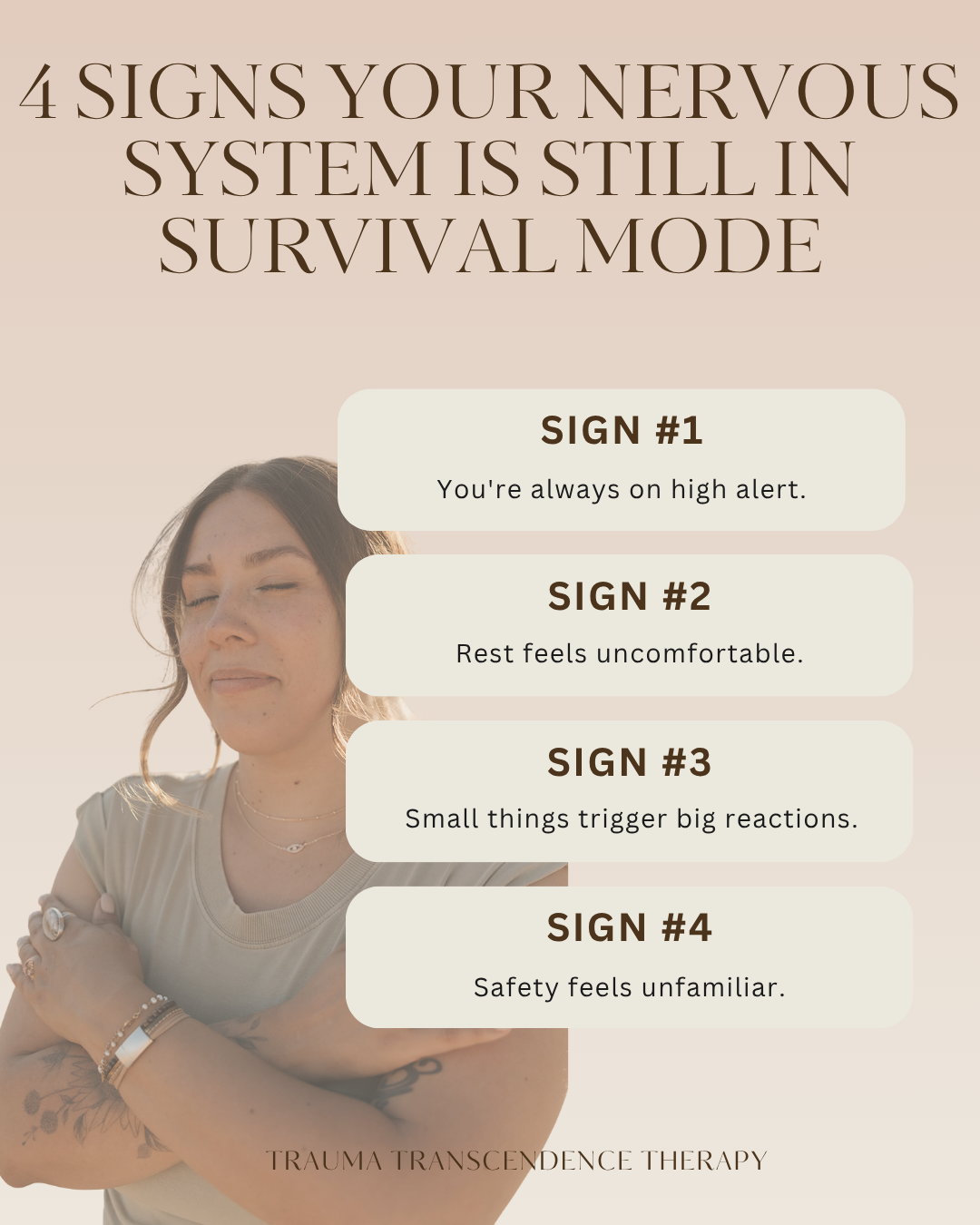
The 4 Signs Your Nervous System Is Still Stuck in Survival Mode
Everyone's nervous system is unique, so survival mode doesn't look exactly the same for everyone. You may recognize yourself in one sign, or you may identify with all four. The important thing to remember is that these responses are not signs of weakness. They're signs that your nervous system adapted to help you survive.
Sign #1: You're Constantly on High Alert
One of the biggest signs that your nervous system is still in survival mode is hypervigilance.
Hypervigilance is your brain and body constantly scanning your environment for potential danger, both consciously and unconsciously. The "danger" your nervous system is looking for is often anything that resembles painful experiences from your past.
For example, if you grew up being criticized, you may become incredibly sensitive to feedback as an adult. You might find yourself analyzing someone's tone of voice, replaying conversations in your head, or wondering if you've done something wrong.
If you've been cheated on before, you may find yourself looking for signs that your current partner is becoming distant. This might look like checking their social media, going through their phone, asking for reassurance, or searching for evidence that something is wrong.
From the outside, these behaviors can look like insecurity or overthinking. Through a trauma-informed lens, they often make perfect sense. Your nervous system is trying to protect you from experiencing the same pain again.
The problem is that when your nervous system is always searching for danger, it often struggles to recognize when you are actually safe.
Sign #2: Rest Feels Uncomfortable
Many people assume rest should feel relaxing. But when your nervous system has spent years preparing for danger, slowing down can actually feel uncomfortable.
If you grew up in a home where you were criticized for sitting down, expected to always be productive, or shamed for resting, your nervous system may have learned that rest is not safe. Even years later, sitting on the couch to relax can bring up guilt, anxiety, or an urge to get back up and do something.
For others, anxiety makes stillness feel almost impossible. You may constantly stay busy, shake your leg, pick at your skin, scroll on your phone while watching television, or always feel like you need multiple forms of stimulation.
Maybe you've gone to yoga but couldn't quiet your mind. Maybe you've had a massage but spent the entire time thinking about everything you needed to do. Maybe you've tried meditation and found yourself becoming more frustrated than relaxed.
When your nervous system believes it needs to stay alert, relaxation can actually feel threatening.
Sign #3: Small Things Trigger Big Reactions
One of the most confusing parts of trauma is wondering why something that seems small creates such a big emotional reaction.
The reality is that your nervous system is constantly comparing the present to the past. It is asking, Have I experienced something like this before?
If the answer is yes, your brain and body may react before you've had a chance to think logically about what's actually happening.
For example, maybe your partner offers gentle feedback, but because you grew up with a critical or emotionally abusive parent, your nervous system experiences that feedback as an attack. You become defensive, argumentative, or completely shut down.
Maybe your partner leaves for a business trip and your anxiety skyrockets because someone else's absence once led to betrayal or abandonment.
Or maybe someone leaves a few dishes on the counter, and you find yourself reacting with intense frustration because, growing up, mistakes were met with criticism, shame, or punishment.
These moments are often less about what is happening today and more about what your nervous system learned to expect from the past.
Sign #4: Safety Feels Unfamiliar
One of the hardest parts of healing is that safety can actually feel unfamiliar.
If your childhood or past relationships were inconsistent, unpredictable, abusive, or emotionally unsafe, your nervous system learned that trusting others could lead to pain.
Even if your current partner is kind, consistent, and emotionally available, your nervous system may continue searching for reasons not to trust them.
You might question their intentions, worry they are pulling away, assume the worst, or find yourself looking for evidence that something is wrong.
This can sometimes show up as needing constant reassurance, becoming controlling, struggling to believe compliments, or having a hard time assuming good intentions.
It isn't because you want your relationship to fail.
It's because your nervous system learned that expecting pain felt safer than being surprised by it.
Healing often involves helping your nervous system learn that the present is different from the past. Over time, with intentional work and the right support, safety can begin to feel familiar instead of frightening.
A Trauma Therapist's Perspective on Survival Mode and Nervous System Healing
One of the biggest misconceptions I hear is, "I know I'm overreacting. Why can't I just stop?"
The answer is that if your nervous system is stuck in survival mode, your reactions often aren't a conscious choice. They're automatic protective responses that developed over time.
As a trauma therapist, I don't see clients as "too sensitive," "too emotional," or "too much." More often than not, I see people whose nervous systems adapted exactly as they were designed to. If you grew up in an environment that was unpredictable, emotionally unsafe, highly critical, or traumatic, your brain learned to prioritize survival over connection, rest, and trust.
One thing I often tell my clients is that your nervous system doesn't know the difference between a past threat and a present reminder. It simply recognizes patterns. If something in your current life resembles a painful experience from your past, your brain may respond as though you're in danger before you've even had time to think logically about the situation.
That's why you might know your partner isn't your parent, yet still feel deeply triggered by criticism. You might know you're physically safe, yet still struggle to relax. You might know someone loves you, yet still worry they'll leave.
These reactions aren't a reflection of your character. They're a reflection of what your nervous system has learned through experience.
The encouraging part is that our brains remain capable of change throughout our lives. With the right support, your nervous system can begin learning that the present is different from the past. Over time, those automatic survival responses can become less intense, less frequent, and easier to understand.
As an EMDR Certified Therapist working with adults throughout Nevada, I help clients understand these patterns through a trauma-informed and attachment-focused lens. Together, we work to process unresolved experiences, strengthen emotional regulation, and help the nervous system experience greater safety and connection. Whether through Attachment-Focused EMDR, individual therapy, or EMDR intensives, the goal isn't to erase your past. It's to help you feel less controlled by it.

How to Begin Healing a Nervous System Stuck in Survival Mode
If you recognized yourself in one or more of these signs, you might be wondering, Now what?
The first step is awareness. You can't change a pattern you don't recognize. Simply noticing when your nervous system shifts into survival mode can create a small but meaningful pause between your trigger and your response. Awareness doesn't mean judging yourself. It means becoming curious about what your mind and body are trying to communicate.
The next step is to replace self-criticism with self-compassion. Instead of asking yourself, "What's wrong with me?" try asking, "What is my nervous system trying to protect me from?" That one question can completely change the way you view yourself. Rather than seeing your reactions as flaws, you begin recognizing them as adaptive survival responses that once served an important purpose.
It can also be helpful to intentionally practice activities that help your nervous system experience safety in the present moment. This might include slow, intentional breathing, grounding exercises, gentle movement, spending time in nature, connecting with safe and supportive people, or practicing mindfulness. While these strategies may not eliminate your triggers overnight, they can help communicate to your brain and body that the danger is no longer happening.
For example, I once worked with a client who became overwhelmed whenever her partner offered feedback. Intellectually, she knew he wasn't criticizing her, but her body reacted as though she were a child again. Through therapy, she realized her nervous system was responding to years of growing up in a highly critical environment, not just the present conversation. As we processed those earlier experiences, she found herself becoming less defensive, more emotionally regulated, and more connected in her relationship.
Another client struggled to rest. Every moment of downtime brought feelings of guilt or anxiety because she had learned early in life that being productive was tied to her worth. As therapy helped her process those experiences, her nervous system slowly began learning that rest was no longer something to fear.
While self-help strategies can be a wonderful place to start, they don't always address the root of why your nervous system feels stuck in survival mode. Trauma-focused therapies, including EMDR, can help your brain process unresolved experiences so your nervous system no longer has to respond as though the past is still happening. If you'd like to learn more about trauma, the nervous system, and evidence-based treatments, I encourage you to explore resources from the American Psychological Association and the EMDR International Association.
You Don't Have to Stay in Survival Mode
If you recognized yourself in one or more of these signs, I hope you leave with this reminder: your nervous system is not broken.
The ways you've learned to think, feel, and respond were adaptive. At some point in your life, they likely helped you survive experiences that felt overwhelming, unpredictable, or unsafe. What once protected you, however, may now be keeping you from experiencing the peace, connection, and security you deserve.
The encouraging news is that healing is possible. Our brains and nervous systems are capable of change throughout our lives. With the right support, your nervous system can learn that the danger is no longer happening. Over time, it's possible to feel less reactive, more grounded, and more connected to yourself and the people you love.
If you're finding it difficult to move beyond survival mode on your own, you don't have to navigate it alone. At Trauma Transcendence Therapy, I provide virtual therapy for adults throughout Nevada, helping clients heal from trauma, strengthen secure attachment, and reconnect with a greater sense of safety using Attachment-Focused EMDR and other evidence-based approaches.
If you're ready to begin healing a nervous system stuck in survival mode, I'd be honored to walk alongside you.
You can schedule a free 20-minute consultation to learn more about how we can work together.

FAQs
-
Yes. After trauma, chronic stress, or painful life experiences, your nervous system can continue responding as though danger is still present, even when you're no longer in danger. This can lead to hypervigilance, anxiety, difficulty relaxing, emotional reactivity, and trouble trusting others. The good news is that your nervous system is capable of healing, and with the right support, it can learn that the present is different from the past.
-
Nervous system dysregulation can develop after trauma, childhood emotional neglect, chronic stress, abuse, relationship betrayal, medical trauma, or other overwhelming life experiences. When your brain and body have learned that the world is unpredictable or unsafe, your nervous system may stay on high alert to protect you, even after the danger has passed. These responses are adaptive, and with the right support, healing is possible.
-
Yes. Trauma can change the way your nervous system responds to the world by making it more sensitive to potential danger. This may lead to hypervigilance, anxiety, difficulty relaxing, emotional reactivity, or feeling stuck in survival mode. While these responses once helped protect you, they don't have to last forever. With trauma informed therapy and the right support, your nervous system can learn that the present is different from the past and begin to feel safe again.
-
Yes. EMDR (Eye Movement Desensitization and Reprocessing) is an evidence based therapy that can help people heal from trauma and reduce symptoms of a nervous system stuck in survival mode. Rather than simply managing symptoms, EMDR helps the brain process unresolved experiences so they no longer feel as emotionally or physically overwhelming. As healing occurs, many people notice they feel calmer, less reactive, more present, and better able to respond to life from a place of safety instead of survival.
-
There isn't a one size fits all timeline. Healing depends on many factors, including your life experiences, the type of trauma you've experienced, your support system, and the work you're doing in and outside of therapy. While some people notice positive changes within a few sessions, for others, nervous system healing is a gradual process. The important thing to remember is that healing is possible. With consistency, self compassion, and the right therapeutic support, your nervous system can learn to feel calmer, safer, and more regulated over time.